QD-Rec's archives during search in three domains
(claude-sonnet-5 proposer). Each map cell shows the highest score among its
recommendations. Red lines extend from earlier recommendations (parents) to the new
recommendation (child) generated from their ideas. The text below each map describes the proposal and whether it is added,
replaces an entry, or is discarded. Companies in the M&A run are labeled by industry.
Introduction
Open-ended search aims to continually produce new discoveries that support further
exploration. Foundation models can generate
candidates by adapting and combining earlier ones.
Recent research on open-endedness has explored creative writing
(QDAIF), adversarial prompts for red teaming
(Rainbow Teaming), and tasks that reveal a model's
capabilities (Automated Capability Discovery).
Other examples include loss functions (DiscoPOP),
research ideas and papers (The AI Scientist), and faster
algorithms and better solutions to mathematical problems
(FunSearch and AlphaEvolve).
The approach has also been used to design agents (ADAS)
and develop agents that improve themselves
(Darwin Gödel Machine, Huxley-Gödel Machine and HyperAgents).
We investigate whether open-ended search can extend to recommendation for decision-making.
Unlike open-ended generation, where foundation models create new artifacts, many real-world
decisions require choosing from a fixed candidate pool. An acquirer must select among existing
companies, and a marketer among available customers. At first glance, a finite, predefined pool
seems to leave no room for open-ended exploration.
However, a fixed set of items does not imply a fixed set of reasons for selecting them.
Even for the same decision maker, each item can be recommended for different reasons. For
example, an acquirer might consider buying a company to gain technology or enter a new market.
The search over these reasons remains open-ended even when the candidate set is finite.
We formalize this task as open-ended recommendation. Its unit of search is an
item–hypothesis pair: a candidate item and a natural-language explanation of why
it fits a decision maker's profile. The profile describes their goals, interests and background.
Our objective is to find a diverse, high-quality collection of these pairs for one profile.
These recommendations give the decision maker different options and reasons to compare before
making the final choice. For high-stakes decisions, the goal is to provide several well-reasoned
alternatives that reflect different considerations. This objective follows the
quality–diversity (QD)
approach of finding a set of high-quality, diverse solutions.
Two properties of this problem shape our approach.
First, evaluation is costly. A recommendation's value is unknown until its hypothesis has been
generated and judged. With candidate pools spanning thousands or tens of thousands of items,
evaluating even one hypothesis per item can exceed the available compute budget. The system
must use previous evaluations to choose which items to investigate next.
Second, the space of possible hypotheses is much larger than the finite pool of items.
Evaluating every item once would still leave many other reasons for choosing each item unexplored.
One way to explore these possibilities is to adapt and combine ideas from previously generated
hypotheses. Even hypotheses with modest scores can be useful in this process: an idea that works
poorly for one item may lead to better reasoning for another. Such hypotheses can serve as
stepping stones, and QD and novelty search provide ways to retain diverse alternatives as the
search continues.
How QD-Rec works
We developed QD-Rec, which takes a decision maker's profile
and a fixed pool of candidate items, and maintains an archive of recommendations.
Each entry contains an item, a hypothesis and a quality score. The system repeats three steps:
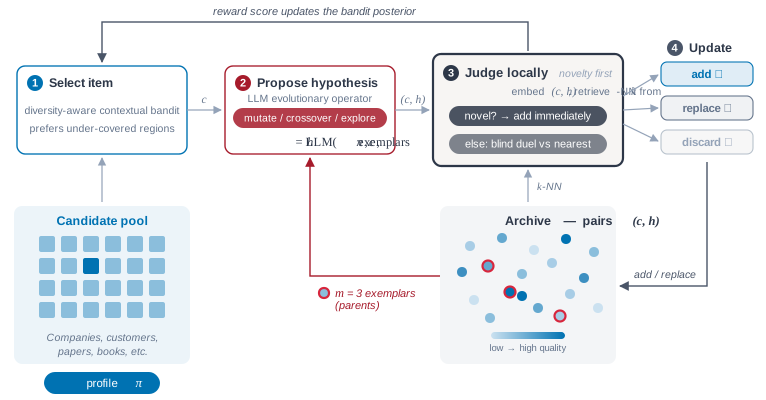
select an item, generate a hypothesis, and decide whether to keep the new pair.
Figure 1. QD-Rec repeatedly selects an item, generates a hypothesis, and updates the archive
through local novelty and quality comparisons.
Select the next item to investigate
QD-Rec uses a contextual bandit to select the next item for hypothesis generation and
evaluation. It uses item embeddings and previous evaluation scores to balance exploitation of
promising items with exploration of
candidates whose potential is less certain.
We further encourage diversity by adding a bonus
for candidates unlike those already in the archive, directing more search toward parts of the
candidate pool that the archive has not yet covered.
Every evaluated recommendation updates the bandit, including those that do not enter the archive.
Note that previous work has also combined bandits with QD, but for different purposes, such as
selecting parents (or bins) from the archive
and choosing how to generate new solutions.
Whereas these methods generate the candidate solutions themselves, QD-Rec uses bandits to
select already-existing items rather than to select parents or generation strategies.
Generate a hypothesis from earlier recommendations
The proposer LLM receives the profile, the selected item and three examples sampled uniformly
from the archive. These examples supply ideas the proposer can adapt to the selected item.
The model uses one of three operators:
Mutate: adapt one earlier hypothesis to the selected item.
Crossover: combine ideas from several earlier hypotheses.
Explore: propose an approach that the examples do not cover.
We call an example used in a proposal its parent, and the new hypothesis its
child. As recommendations enter the archive, they become available as parents for later
proposals. This lets useful reasoning carry over between different items.
Keep new ideas and improve similar recommendations
An evaluator scores the new item–hypothesis pair. To decide whether to keep it, QD-Rec compares it
with nearby entries in the archive. We embed the item description together with the hypothesis
text and retrieve the three entries with the highest cosine similarity.
The archive update then asks two separate questions.
Does it offer a new reason? An LLM judge reads the profile, the new pair and
its three neighbors. If it judges the pair novel, the pair enters the archive without needing
to beat an existing entry's score.
If it is not novel, is it better than its nearest neighbor? The judge compares
the two recommendations in a blind pairwise comparison. Their order is shuffled, their scores
are hidden, and the judge is not told which is new. The new pair replaces its neighbor if it
wins; otherwise it is discarded.
This local competition follows the idea of ecological niches. Recommendations with
distinct reasons can coexist in different niches, while similar ones compete within a niche.
A new reason can be retained even if its current score is low. It can then
provide an idea for a later proposal. This archive design follows recent QD systems that use
embeddings to identify similar entries.
Applications and experimental setup
We test QD-Rec in the following domains.
M&A target discovery. We search approximately 6,300 US companies for acquisition targets
and reasons to acquire them. The acquirers are Walt Disney Co and JPMorgan Chase & Co.
Candidate data come from LSEG Workspace and include business descriptions averaging
approximately 123 words, industry categories and seven financial fields. The financial
snapshot is dated August 31, 2024.
Marketing. We search 10,000 fictional customer profiles for promising targets
and reasons a product might appeal to them. The profiles average approximately 685 words.
The products are a desktop 3D printer and an online learning subscription. The customers are
sampled from the California profiles in NVIDIA
Nemotron-Personas-USA.
Paper recommendation. We search the titles and abstracts of approximately 17,500 papers
accepted at ICLR 2026, ICML 2026 and NeurIPS 2025.
For each selected paper, the proposer writes a research memo connecting it to the interests
of an open-endedness researcher or an applied researcher at an AI startup.
Our paper also studies book recommendation using recorded human ratings instead of LLM quality
scores.
Ablation study
We compare QD-Rec with two ablations, simpler versions that remove components of the
method. All three use the same novelty check and local replacement rule, so their differences
concern which items they investigate and how they write hypotheses.
Novelty selects items uniformly at random and writes each hypothesis from
scratch, without examples from the archive. This is the baseline without evolution.
Novelty+Evo also selects items uniformly at random, but generates hypotheses
using archive examples and the mutate, crossover and explore operators.
QD-Rec keeps those evolutionary operators and adds the diversity-aware bandit
to learn which items to investigate next.
Method
Local novelty filter
Evolutionary operator
Bandit item selection
Novelty
✓
×
×
Novelty+Evo
✓
✓
×
QD-Rec (full)
✓
✓
✓
Table 1. QD-Rec and its two ablations. All three use the same archive update: novel recommendations
are added, while non-novel ones replace their nearest neighbor only if they win the local
quality comparison.
Models and evaluation budget
We run each of these six scenarios with two proposers, claude-sonnet-5 and
claude-haiku-4-5. The evaluator is gpt-5.6-terra for quality scoring,
novelty checks and pairwise comparisons, to cope with self-preference
bias.
Each run starts with ten seed recommendations, followed by 1,000 evaluations. We repeat each
configuration with five random seeds and give the three methods the same initial archive for
each seed. The seeds control sampling such as item ordering and parent selection; LLM sampling
stays at the provider default.
Candidate and archive embeddings use OpenAI's text-embedding-3-small at 512 dimensions.
Metrics
Four metrics summarize the final archive of a run.
Quality is the mean score of the archive's entries, as rated by the judge
from 0 to 10.
Diversity is one minus the mean pairwise cosine similarity of the entries'
embeddings.
Coverage is the fraction of occupied cells on a 25×25 grid over a 2D PCA
projection of the embeddings (the maps in the replay at the top of the page). For each profile, proposer and seed, the
projection is fitted on the final archives of all three variants together, so Coverage is
comparable across methods.
Archive sizen is the number of entries that survived
admission.
The scores used to report Quality are the same scores available during search. The experiment
measures how well each method uses a fixed evaluation budget to build its archive under that
evaluator.
Example recommendations
Two examples show how an earlier hypothesis can be adapted to a different candidate.
Both examples use the claude-sonnet-5 proposer
and gpt-5.6-terra judge. In the excerpts, [...] marks text omitted from the generated hypotheses.
Recommending that JPMorgan acquire a travel review and booking company
M&A (acquirer: JPMorgan Chase & Co)
The Novelty baseline found little reason for JPMorgan Chase & Co to acquire Liberty TripAdvisor
Holdings. It argued that Chase Travel and existing partnerships already provided access to
similar benefits, and recommended against the acquisition. The judge assigned the proposal
a score of 1/10.
Novelty, without exemplars (score 1/10):
This deal lacks strategic logic: JPMorgan is a diversified financial holding company (banking, markets, asset management) while Liberty TripAdvisor is a consumer travel marketplace business with no meaningful overlap in capabilities, technology, or customer needs that JPMorgan doesn't already access via its Chase Travel platform and existing card-linked travel partnerships. [...] Any travel-related synergy JPMorgan seeks (e.g., enhancing Chase Sapphire travel benefits or Chase Travel bookings) can be achieved more efficiently through commercial partnerships or licensing rather than full acquisition and integration of a publicly-troubled, sub-scale asset. We recommend against pursuing this acquisition given the poor strategic fit and absence of compelling synergy rationale.
QD-Rec drew on an idea from an unlikely source: a proposal to acquire Southwest Airlines.
This earlier hypothesis argued that owning the airline would connect travel purchases more
directly with JPMorgan’s financing, payments and rewards services. However, the judge considered
the acquisition impractical, citing airline operating risks and restrictions on bank ownership
of nonfinancial businesses. This proposal also received 1/10.
Parent, for Southwest Airlines Co (score 1/10):
Southwest Airlines is unusually well-suited to JPMorgan given the bank's existing role as issuer of the Southwest Rapid Rewards co-brand card portfolio, one of the largest travel rewards programs in the country; full ownership would let JPMorgan capture the entire loyalty-program economics—breakage, points sales, and ancillary fee revenue—rather than sharing them through an issuing partnership, [...] At an EV of $15.3B, Southwest is trading below its levels of two ($15.8B) and four years ago ($17.5B) despite a modest 1.3% YTD gain, offering JPMorgan an opportunity to acquire a top-tier domestic airline brand and its 100+ million-member loyalty base at a valuation depressed by sector-wide fuel and margin pressure rather than by any structural decline in Southwest's franchise. Vertical integration would let JPMorgan embed banking, financing, and payments products directly into the travel purchase funnel—installment financing for fares through Chase's balance-sheet lending, bundled Chase Travel booking, and richer transaction data for underwriting and cross-sell into CCB's card and deposit products. [...] though it would require JPMorgan to underwrite genuine airline operating risk (fuel, labor, capacity cycles) that sits outside its traditional risk models.
Using the Southwest hypothesis as a parent, QD-Rec generated a new rationale for acquiring
Liberty TripAdvisor. The proposal connected its travel marketplaces with Chase’s booking,
payment and rewards services, and identified opportunities to offer financing for activities,
dining and accommodation. It carried over the idea of integrating financial services into
travel purchases, without requiring JPMorgan to operate an airline.
Child, QD-Rec (score 5/10):
Liberty TripAdvisor's three marketplaces—Tripadvisor, Viator, and TheFork—represent a global audience of travel researchers and bookers that JPMorgan could plug directly into Chase Travel, its growing proprietary booking platform, and into Chase Offers and Ultimate Rewards redemption, capturing interchange, points-funded bookings, and installment-financing revenue on activities, dining, and accommodations that currently flow to third-party payment rails. [...] At a $2.08B enterprise value—down sharply from $3.39B three years ago and off 49% YTD—the company is trading near a multi-year low, [...] Owning these consumer touchpoints would also generate rich transaction and behavioral data to sharpen underwriting and cross-sell into Chase's card and travel-rewards products, [...]
The judge rated this Liberty TripAdvisor proposal 5/10, compared with 1/10 for the baseline’s
independently generated proposal for the same company. Concerns remained about competition
and whether partnerships could deliver the same benefits. Even so, the Southwest hypothesis
had supplied a useful starting point: an idea from a proposal rated only 1/10 became a stepping
stone toward a more highly rated recommendation for a different company.
Recommending an online learning subscription to a nurse who plans a community screening program
Customer targeting (product: SkillForge, a fictional online learning subscription)
Here, the task is to find customers for SkillForge, a fictional monthly subscription offering
business, technology and creative courses, and explain why it could appeal to them. The
candidate is Jesus Montalvo, a fictional 29-year-old nurse in National City, California. He
wants to earn a nursing degree, become a charge nurse who leads a team, and start a preventive
health screening program in his hometown.
The Novelty baseline wrote its hypothesis from scratch. It recognized that courses such as
project management could help with the screening program, but dismissed this as
“a peripheral use case”. It also treated his shift work as an obstacle to finding
time for study and concluded that the service was a poor strategic fit. The judge gave the
recommendation 2/10.
Novelty, without exemplars (score 2/10):
Jesus's near-term career goals are almost entirely clinical—finishing his BSN, becoming an FNP, and building a community health outreach program—none of which SkillForge's business, tech, or creative tracks can substitute for, since it offers no accredited nursing or healthcare credentialing. While he might be mildly drawn to the Business Track's project management or data analysis modules to sharpen his charge-nurse leadership and eventually structure a preventive-screening program, this is a peripheral use case rather than a core need, and his already packed per-shift schedule plus stated preference for unstructured downtime (hiking, guitar, cooking) makes committing another 3-4 hours weekly to a subscription-based platform a hard sell. [...] SkillForge is a poor strategic fit for this persona despite superficial overlap in the 'practical skill-building' ethos.
QD-Rec's archive contained a highly rated hypothesis about a different customer: Sharon English,
a fictional 46-year-old kindergarten teacher who wants to move into district-wide leadership.
Parent, for Sharon English (score 7/10):
Sharon's explicit ambition to move from the classroom into a district-wide leadership role—developing STEM curricula and mentoring other teachers—requires competencies her ECE and STEM pedagogy training doesn't fully provide: project management to roll out a district-wide program, data analysis to evaluate learning outcomes, and polished presentation skills to advocate for inclusive policies to administrators and school boards. SkillForge's Business Track maps directly onto these gaps, offering practical frameworks she could immediately apply while still pursuing her master's degree. Her comfort with structure, spreadsheets, and hands-on STEM tools also makes the Tech Track's approachable Python and data courses appealing, letting her build lightweight tools or dashboards to track her STEM curriculum's impact—something she could point to when pitching herself for a curriculum specialist role. [...]
This parent positioned the service as a way to gain skills needed for leadership that her
teaching training did not fully cover: project management, data analysis and presentation.
The judge gave it 7/10.
QD-Rec's mutate operator adapted this reasoning to Jesus. Like the teacher,
a nurse moving into management or program leadership may need business skills beyond their
professional training. The child used these needs as the reason to recommend the service.
Child, QD-Rec (score 7/10):
Jesus's stated goal of becoming a charge nurse and eventually launching a preventive health outreach program in National Cityrequires competencies his clinical training never covered—project management to coordinate a screening initiative, basic data analysis to track and report health outcomes, and polished presentation skills to pitch the program to hospital administrators or grant funders. SkillForge's Business Track speaks directly to that gap, while the Tech Track's approachable data courses could let him build simple dashboards to demonstrate the impact of his community screenings, reinforcing his evidence-based, protocol-driven mindset. His per-shift, flexible work schedule and self-described tendency toward disorganization make the platform's structured 3-4 hour weekly cadence, dashboard progress tracking, and cancel-anytime plan especially appealing, [...] While SkillForge can't replace the BSN or FNP coursework he ultimately needs, it fills a real and immediate void in the program-management and advocacy skills his broader career vision demands, making him a solid niche fit despite the platform's non-clinical focus.
Skills that the baseline dismissed as peripheral became central to running a screening program
and presenting it to hospital administrators. The child also interpreted shift work differently:
the service's flexible format could suit an irregular schedule.
The judge found this specific connection between his goals and the skills credible and gave
the child 7/10. The teacher's hypothesis served as a stepping stone by providing a new way to
assess a different customer. It helped QD-Rec find a persuasive reason to recommend the service
to a nurse whom the baseline had judged a poor fit.
Quality and diversity in the resulting archives
Higher quality with larger archives in most settings
Table 2 reports the four metrics for the three variants on both profiles of each of these three
domains, under both proposers.
Domain
Profile
Proposer
QD-Rec
Novelty+Evo
Novelty
Qual.
Div.
Cov.
n
Qual.
Div.
Cov.
n
Qual.
Div.
Cov.
n
M&A
Walt Disney Co
Sonnet 5
2.91±0.05
.352±.001
.26±.00
214±2
2.51±0.07
.353±.001
.18±.01
135±5
2.40±0.12
.330±.001
.12±.00
85±1
Haiku 4.5
2.55±0.03
.318±.001
.27±.00
262±5
2.11±0.04
.322±.002
.23±.01
188±4
2.12±0.05
.326±.002
.19±.01
143±4
JPMorgan
Sonnet 5
3.04±0.04
.353±.001
.23±.00
183±5
2.54±0.08
.363±.003
.15±.01
108±4
2.88±0.04
.332±.001
.13±.01
95±3
Haiku 4.5
2.71±0.02
.316±.001
.28±.00
238±7
2.17±0.04
.324±.003
.22±.01
166±9
2.25±0.04
.331±.001
.20±.00
150±3
ML Papers
OpenEndedness
Sonnet 5
5.32±0.02
.501±.001
.44±.01
730±8
5.26±0.02
.479±.002
.47±.01
690±8
4.96±0.02
.469±.001
.43±.01
578±5
Haiku 4.5
4.87±0.02
.523±.002
.30±.01
353±34
5.03±0.07
.504±.002
.26±.02
247±31
4.26±0.02
.489±.001
.39±.01
468±9
AI Startup
Sonnet 5
6.24±0.02
.521±.001
.45±.01
789±8
6.24±0.03
.502±.001
.48±.00
737±8
6.21±0.01
.495±.001
.46±.00
658±7
Haiku 4.5
5.83±0.02
.526±.002
.43±.01
720±6
5.87±0.03
.507±.001
.47±.01
674±12
5.81±0.02
.516±.001
.46±.01
616±4
Marketing
3D printer
Sonnet 5
7.05±0.05
.243±.001
.18±.00
164±2
6.73±0.01
.237±.001
.18±.01
156±5
6.81±0.04
.219±.001
.13±.01
96±4
Haiku 4.5
6.83±0.03
.199±.001
.13±.00
104±3
6.29±0.02
.202±.002
.14±.00
110±3
6.65±0.05
.190±.003
.11±.00
80±3
Upskilling
Sonnet 5
6.89±0.06
.235±.001
.11±.00
82±3
6.70±0.06
.230±.002
.10±.00
72±3
6.47±0.08
.225±.001
.09±.00
61±1
Haiku 4.5
6.62±0.10
.245±.002
.07±.00
54±3
6.35±0.12
.238±.005
.08±.00
58±3
6.47±0.03
.221±.001
.08±.01
69±4
Table 2. Mean ± standard error over five seeds. Sonnet 5 and Haiku 4.5 are the
proposers claude-sonnet-5 and claude-haiku-4-5. All results use
gpt-5.6-terra as the judge. Quality is the judge score from 0 to 10.
For each profile, proposer and metric, shading marks the
best mean and every cell not
significantly different from it (paired two-sided t-test across seeds,
p \ge 0.05, uncorrected). The three variants share each seed's initial archive. A
single shaded cell is therefore significantly better than both other variants.
QD-Rec generally matches or improves on the two ablations in Quality and Diversity. It also
builds the largest archive in most settings, retaining more distinct recommendations within
the same evaluation budget.
Quality and archive size over the run
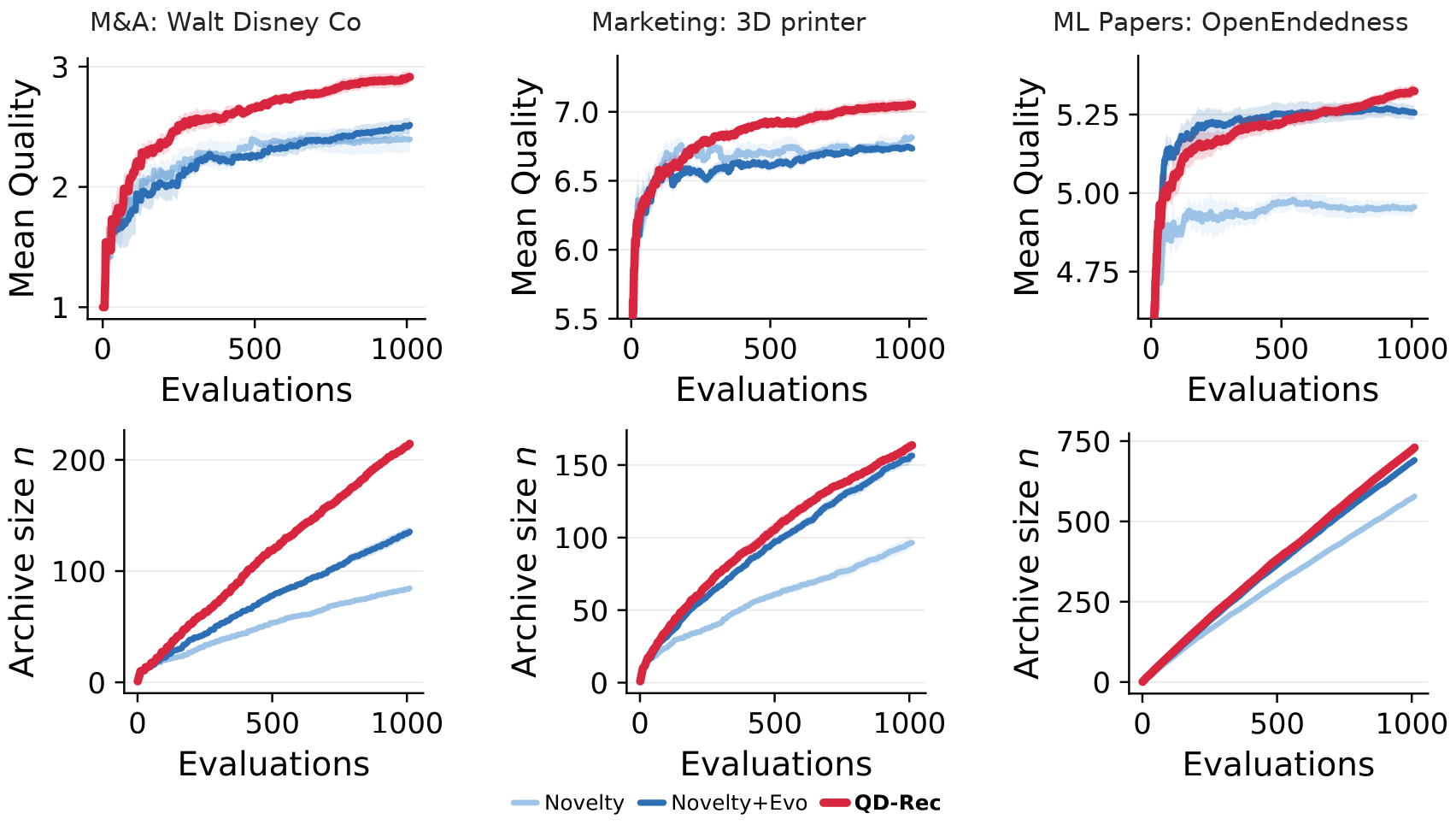
The run histories show how these archives develop. Figure 2 follows one profile from each
applied domain with the Sonnet proposer. QD-Rec's mean Quality rises over the course of these runs
and finishes highest. Its archive also grows as new hypotheses are admitted.
Figure 2. Mean Quality (top) and size n (bottom) of the current
archive after every evaluation, for one profile from each applied domain
(claude-sonnet-5 proposer, mean ± standard error over five seeds).
Novelty writes each hypothesis from scratch. Novelty+Evo evolves hypotheses using archive
examples. Both select items uniformly at random. QD-Rec uses a diversity-aware bandit to learn
which items to investigate next.
Conclusion
QD-Rec uses open-ended search to build an archive of diverse recommendations for decision-making.
Each recommendation includes a reason for choosing the candidate, helping people compare
different possibilities. The system combines a contextual bandit for item selection, an LLM for adapting
hypotheses, and local comparisons for archive management. Across the domains and two proposers,
QD-Rec achieved the highest mean Quality in most settings and usually built the largest
archive.
We kept the system relatively simple in this study. Future work could extend its three core
components in several ways:
Advanced item selection: Replacing the linear predictor with neural
contextual bandits could capture nonlinear relationships between item features and
rewards.
Richer hypothesis generation: Broader data and external research tools could
help the proposer generate recommendations with stronger supporting
evidence.
Selection of archive examples could also account for quality, recency or previous use instead of sampling
uniformly from the archive.
Bandits could also be used for parent selection, in addition to item selection.
Human-in-the-loop judging: Domain experts could replace or supplement the
LLM judge when subjective preferences or experience matter. Their reviews could help detect
reward hacking, where proposals exploit the judge to obtain high scores without improving quality.